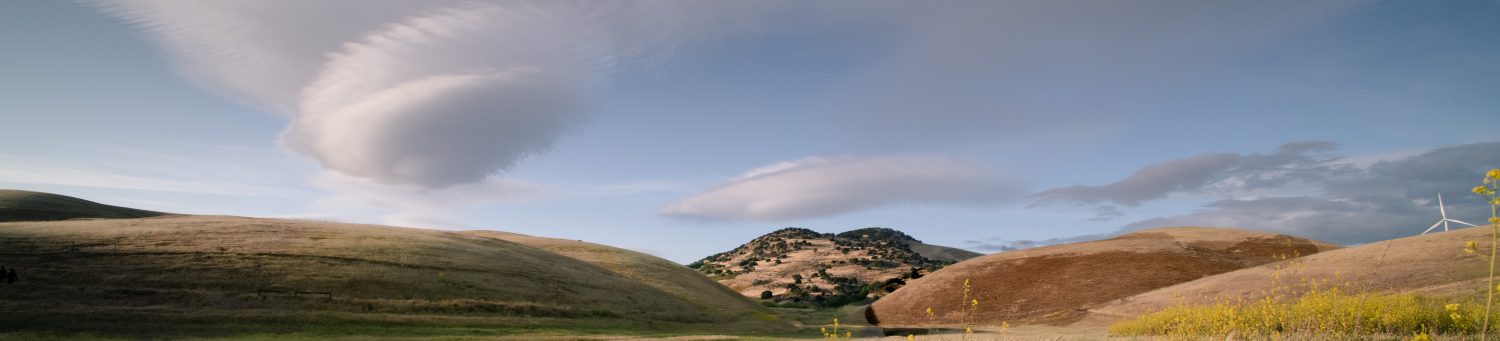

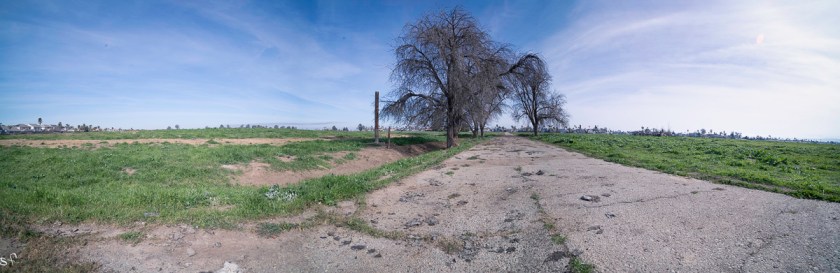
Point Of Timber Road ends in a locked gate and a sprawling field that abuts Discovery Bay in Brentwood. By now it most surely is tract housing. In 1848, Murrieta’s time, it was John Marsh’s territory and included the rodeo grounds just west of the San Joaquin marshland
Rancho Los Meganos land grant 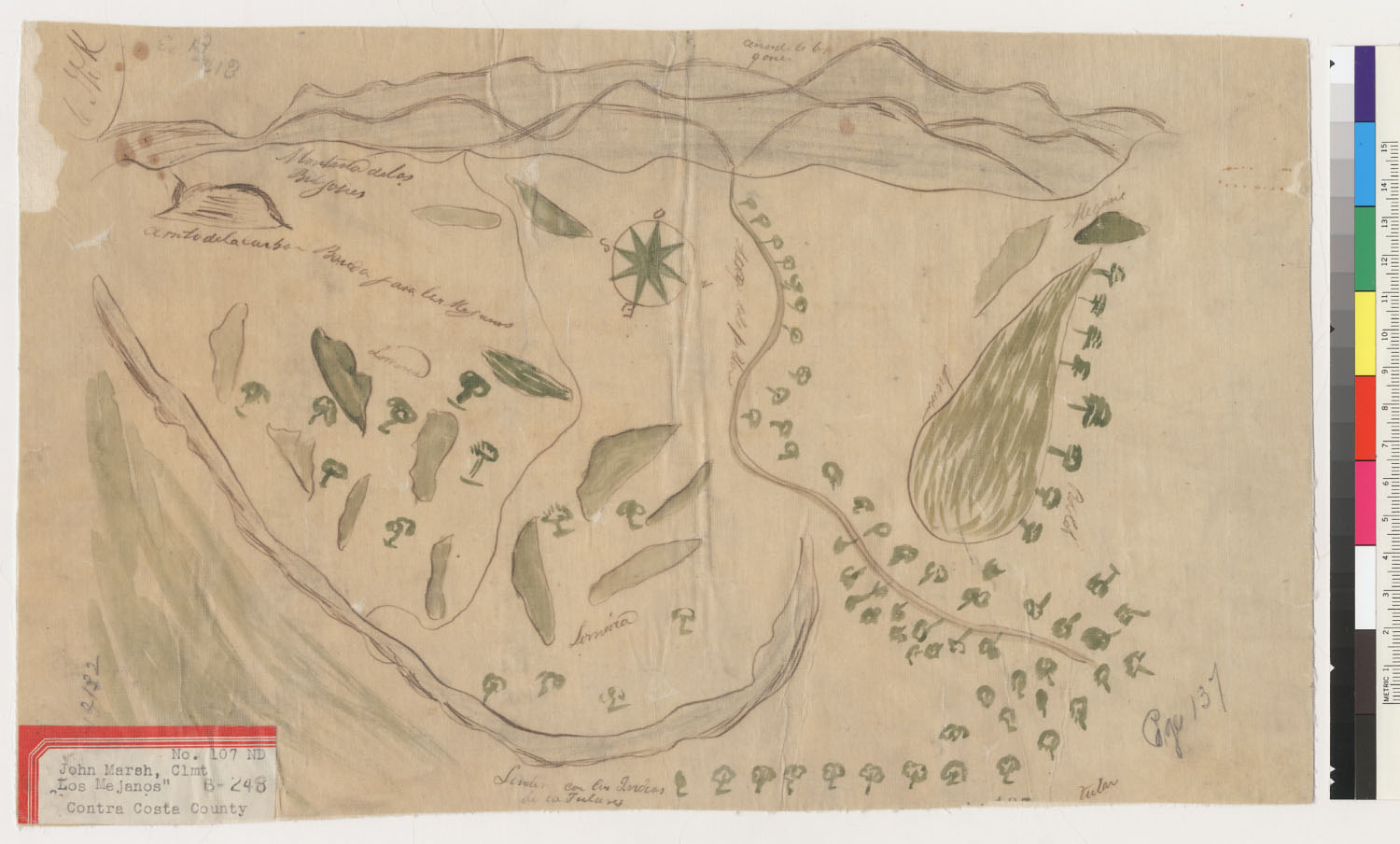
was once church land, Marsh bought it for a song when Mexico seceded from Spain. The forested area in the lower right mark the Point of Timber, where once stood four square miles old growth oak. This was Marsh territory, the first white’ settler in Alta California,
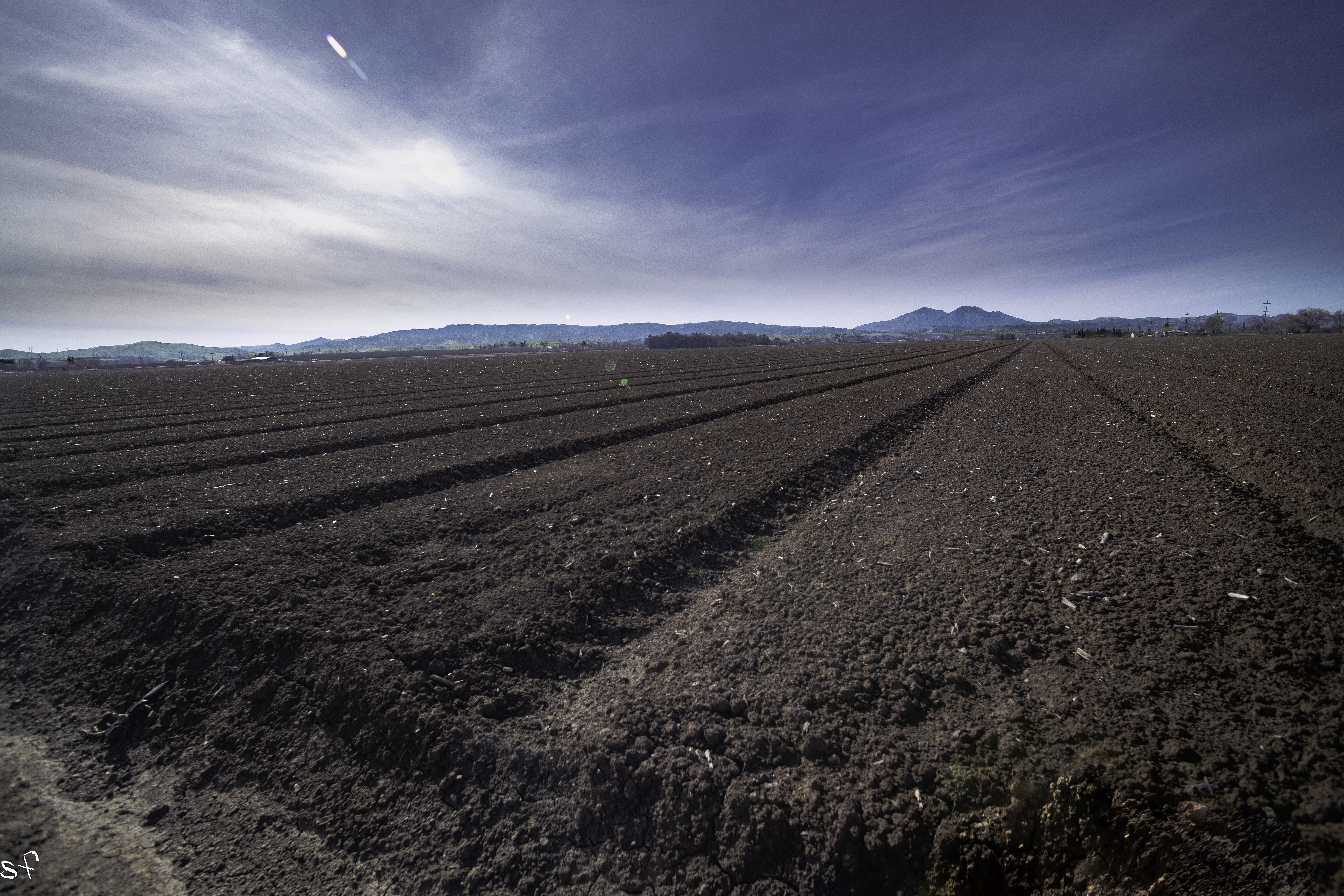 In 1848, when Murrieta arrived in California, the rodeo grounds just west of the San Joaquin marshland, was a place to find work. Vaqueros from all over the east of Contra Costa, would where the California mustang were gathered and made ready for the the trail south Long before Murrieta, Marsh would gather and brand his herds, set wild to pasture on the open lands around Mt Diablo, at the end of summer they were gathered, corralled and branded. Murrieta and his mustang runners gathered as few as fifty horse and the drove along the Mountain Path, La Vereda del Monte, it is where the monthly horse droves begin. The California horse drovers who worked under Murrieta, and their trail, three hundred miles down the backbone of the southern Diablo range, were the some of best horsemen in the State, which is to say the world, for the Californo, was on the back of a horse, not just any horse, but a fine one, from the time he could walk and one reason Bancroft, and Richard Henry Dana remark that from that time on, they never did . Walking was something that horses did and did it well, and other things too, like breaking into a gallop that was faster than anyone pursuing you, and what that meant – you got away. Murrieta often got away on the back of el Tigre, reputed to be the fastest horse in the west, or at least faster than the sherriff’s. The migration of wild horses in California is very much apart of this story, to be alive at this time is to be of it, just as much as we associate with our cars, it is part of culture.
When I as in the fourth grade we went on a field to the Stone House, listened to tales of John Marsh having fled Massachusetts under dubious circumstances, became Don Juan Marsh, a citizen of Mexico, then a Roman Catholic, all so he could purchase a land grant, initilly owned by Spain, now ceded to Mexico. a 100 years later when I was inhigh school, there was a road named after him, and on summer nights sometimes we would drive out Marsh Creek and listen to the bullfrogs, Marsh’s Ranch extends from the San Joaquin west toward Mt Diablo, about as far as the eye can see. more or less it was grassland in his day, he hired vaqueros to run his herds, brand his livestock, drive them to San Francisco where they where butchered and dried into jerky. When Murrieta came up from Sonora on his way to his brother in law’s claim in the gold fields on the Mukelomne River, he worked as a mesteneros at the place I am looking at as I drive west toward the mountain, and was, most likely, under the hire of Marsh, he certainly knew Marsh, everyone knew Don Juan. And it hits me for the tenth time today, this is the same route Murrieta’s horse runners took a hundred and seventy five years ago, at the beginning of this state’s history, the state I was born in, California, and as I look out toward the mountain. a mountain I know well, Ive been to the summit a dozen times, and rock city, and campouts, and this was a landmark to all who passed, long before any European , ever since people have been speaking to one another, the great mountain to the west, as I look, was a reference. I find this interesting, and obsess for a while, even the Miwok, long before this tale begins, owned the mountain, and
I am traveling over the same land with the same geography, more or less, right now, that mounain was ecatly the same distance away as it was during Murrita’s time. Somehow I find this fascinating. Murrieta on a horse, or Dr John driving his wife to church in a carriage. they may have even tipped hats in passing. Maybe not, Marsh was somewhat of a racist, but remember Murrieta was a huerro, a blond one, and often passed as cucassion. He also spoke fluent English. Marsh was the first white to cultivate land, and the first settlement to be seen after crossing the implacable sierra through the Truckee pass and then later his settlement became something of an empire that 49ers came to in droves on their way to the gold fields hoping to make it rich. His dry goods business catered to the novice miner, who dumped their real jobs when the fever hit, knew nothing about mining, and were looking for a pick or a good iron pot and some hard tack bypass Stockton entirely and get to the Stanislus by a shorter rout – it was an aggressive game, and the bird who got there first got all the worms. Marsh stayed at home on his ranch and became one of the wealthiest businessmen in California – made more money off the mother lode than most without the hardship. He also made a lot of enemies. Never having lost his whiteness, the racial divide between the Mexican, the Californio, and el jeffe, the Anglo, Marsh was seen as repugnant to many a vaquero – for one thing, during the Yankee incursion, he fronted Fremont, culminating in the Bear Flag Revolt, he knew what side his bread was buttered on, and this in itself brought with it a strident racism. Marsh, to many a vaquero, was a landlord who usurped the land, he paid them to do what they loved, play with their reattas and ride, but he was el jeffe.
We know of Marsh’s checkered past from Massachusetts, by the time this narrative plays out he had been a country doctor and brought many a child into this world, but was technically a fraud. How this directly plays into Murrieta’s story we shall see, as I am driving, the way the light is playing off this farmhouse is amazing so I pull of the road and walk up the driveway and as I am framing a shot this voice comes from behind a screen door, from a gaping black abyss in the hard sun that asks me “What are you doing?”, a fair enough question, but not one that is easily answered as I am on her property, so I answer her as honest as I can and tell her, “I’m shooting a picture.” which she can plainly see with her own eyes, even though I cant see them, because they are part of this disembodied voice coming from a cavern in the side of her house.
Claudio Feliz, the brother of his wife Rosa Feliz, raided Marsh’s Ranch in 1852. This event is well documented and equally misunderstood, Murrieta, Marsh, and Esstacione #1 at Point of TImber where We begin our story, and how the Feliz gang – the Happy Gang – impacted events two years before is worth taking a closer look at I852 Cladio, expelled from the gold fields, mistreated by racist white indignant, and capable, made him two years before, after posing as an Argentine horse trader all afternoon at the Marsh Ranch, he returned later in the evening and robbed the place, killing the employee who was in charge – apparently Marsh was out on a ‘house call’
History is mute on whether he was the intended target. Marsh thought so, he was paranoid, some of it real, real enough for him to build a castle in the wilderness, the stone house, a fortress by the standards of the day, only rivilled by Sutters’ Fort, to the north. The stone house hadn’t been built, and Claudio’s raid, motivated as much by racism as anything, was an extreme expression of a broader sentiment shared by many a vaquero, Cladio simply had the nerve to put his ‘revolt’ a violent one, and difficult to condone, but much more complicated than the telling of the tale in such broad strokes as he went on a killing spree, after Marsh came a ranchp in San Jose, then, finally Claudio Feliz, Murrita’s brother in law, butchers the wrong dude, a Califorio, a native, and so, according to Mero’s distortion of events, had not the sympathy from the law to pull off another one, was hanged. However this hardly takes events, but on it’s surface and the significance of Claudio Feliz deserves a much closer scrutiny. For one thing, his death meant that his ‘gang’ needed a boss, and here is where Murrieta steps up in, His brother in law, known to him all of his life, an older brother, who Murrieta,, in his schools days, looked up to, even revered, was gone. Perhaps. One thing is certain, Murrieta wa several years yonger, even than most of Feliz Gang, and why it is that he immediatly assumes leadership, and in a authoritative way, is remarkable. It speaks to Murrieta’s charcter, a cornerstone of this narrative, and one we will explore by the by, for now, much water has pased under the bridge in the last year of Murrieta’s life, indicative of an explosive life changing event, like a tsunami and the aftermath from under a bridge, or from the ashes, Murrieta is reborn, he has crossed the rite of passage by avenging his brother’s death, is also Claudio’s story, and from there to where our story begins, at the first station, just prior to the droving season in the year 1852, must be understood, at least as I see it while driving west, the mountain growing largr, looming now, and invitation on the horizon. I recall the story, how Claudio raided the Marsh farm, and bushwacked a path to Sn Jose where he met his demise, the year before and how influential he was, initiating many of the directions Joaquin would take, for one he was no idiot, the ambush appears to have been done with some planning and took a certain authority to pull off, posing as an Argentine horse trader, of some wealth, who would have had to provide references and conduct himself in a certain manner, belies the image of a brigand.
“I love Rosa with every fiber of my body, her story is so well known that I refuse to listen to it and ride away whenever Pedro makes his remarks, or just change the subject and give him the eye, he knows it bothers me, sometimes I want to slit his throat, but I cannot, and I know I cannot, he is as much of a brother to me as Jesus, or Claudio. What’s been done is done, I have no regrets for my part, Pedro, on the other hand, will have to answer for his sins, he is a fool, and a mad man, but still he is my brother. Everytime we pass by Meganos he talks of Claudio and how he too wants steal his horses and see if he will give chase and then gun him down on the road. I know he is only joking, but sometimes his jokes are for idiots, they dont make you laugh, they dont even make sense, I hate Marsh as much as any vaquero, I have worked for him, which means to be robbed by him, But I dont wish him dead, and besides what better way to bring the marshal here and destroy the one livelihood we have left. I tell him, like I did the other day, to keep his head or I will cut him at the knees. But like always, he does what he wants. I dont have time for his blowback, and neither does he. We need twenty more horses, Necesitamos encontrar veinte caballos…veinte mas, and then we leave.”
Murrieta here is referring to Pedro Gonzales, aka Three Fingered Jack, a prominent figure in this story, the two are inseparable, yet he embodies the opposite side of character in almost every way. Gonzalas, according to Latta, is not a blood relative, but was born in the same town in Sonora, under the same roof, as it appears on birth records. This was likely the home of a common midwife, a speculation, but one thing is certain, they had known one another from birth, and so, like his blood relatives and those of his ‘in laws’ through Rosa, who he had also know since birth, were tied at the hip. The savagery of Gonzalas’ actions caused great friction between the two men and led to quarrels, but Murrieta never banned him from the gangs activities or profits. He was, as all of the vaqueros under Murrieta’s charge, an accomplished horseman. One could certainly argue that Tres Dedos was a ‘lieutenant’ in Murrieta’s gang and when needed could supply a necessary brutality. The murders of several. including ones under his charge as ‘prisoners’ tied to a tree, certainly led to the reputation of Murrieta being a homicidal maniac, despite the fact that he had nothing directly to do with the slayings. Murrieta murdered men, to be sure, and we’re going to get to that, but, as we shall see, there was a motive behind his actions, perhaps a questionable one, unjustifiable to some, but no where near to the extant than the violence of Tres Dedos.
mesteneros. in 1839, Marsh bought the land grant and was the first ‘white’ settler in the region. At times the fog is so thick you can’t see your fingers through the tulles, or the great mountain in the distance. The tulle fog along the banks of the San Joaquin, was so thick at times you couldn’t see your fingers through the reeds, or the great mountain in the distance and made the the oaks impenetrable, except to wood nymphs, grizzly bears. The Yokuts, managed to elude the Spaniards when Fages tramped through the area in the early 1760’s, and it made for an enchanted setting beneath clear skies under the gaze of the great mountain in the distance, This is where Murrieta’s horse droves begin. There was little room to maneuver, the operation depended on crew down the line and a rigid schedule had to be adhered to in order to minimize casualties in the herd. The droves left in the middle of the month, every month for the entire season. The size of the herd was targeted at 300 head, the maximum amount that could survive the run into Arizona an then into Sonora. Murrieta’s job was to gather the herd to this number and he had approximately 250 miles to do it, down the spine of the Mt Diablo Range, fattening the herd from the San Joaquin as he went. This is another reason for a series of semi formable enclosures, it wasn’t just a holding pen for the migrating herd, part of the task of the crew at each of the stations was to gather feral, roving, or unguarded horses from as far east as the San Joaquin River to Lake Tulare and the plains in between.
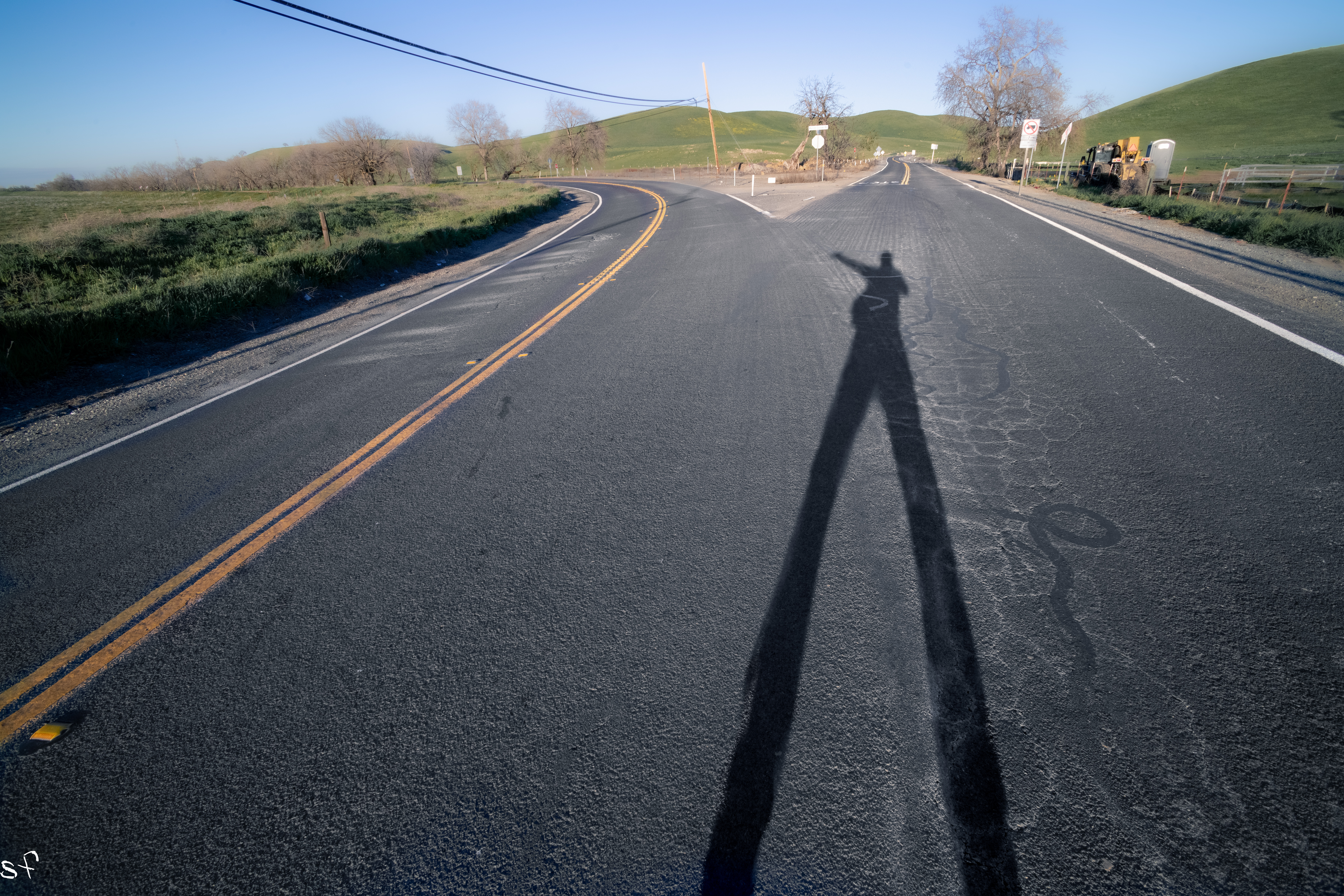 There is a long plateau just east of Marsh’s ranch, and extends all the way to the timber, and the rodeo in September was common to all, for decades, herds of wild mustang were rounded up at this spot and ferrel horses, roaming the San Joaquin were free to anyone who could rope them, the plains east of Diablo had herds, once the champions at the mission in San Joses, thirty miles to the south, when the church forfeited its land to Mexico, entire livestock became part of the landscape. Here, at the rodeo grounds is where the ownership of each animal is declared. Any unbranded horse became the property of the vaquero who wielded the iron , Murrieta’s brand was the Tres Piedras, a reference to one of the last estaciones on the trail and a place of significance where Murrieta hid with his crew, bathing in the chill waters at Spanish Lake, waiting for a signal from Valenzuela to deliver the herd. But I am way ahead of my story, we are the fisrt station, Estacione #1 and there is much more to tell about the rodeo, and rounding up horses, the start of the droves and Marsh’s Ranch. Murrieta’s role too begins here but three years before, when he first came up from Sonora Mexico with his wife Rosa who was from his home town, and was only 15. A lot had happened in those three years. Now, in early September, the horses are cobbled together in drags, and stand shivering in the early fog, and Murrieta is tending to them, his own horse Mozo is saddled and waiting, stamping his giant hoof on the ground, jets of steam shoot from his nostrils. Murrieta might laugh and calls out to his favorite horse, not his fastest horse, not el Tigre, but his favorite. He maybe had a hundred head, ten came in just that day and the irons were still warm, so were the beans and there was coffee and guitarras to pass the night. He needed forty more head at least, and he needed them in the next two days or leave with a short herd. “Whatever.” he called back to the owl, screeching now and again for its mate. Come what may, he would leave on the fifteenth. He would cobble together what ever herd he could in drags, to slow them over the next 300 miles, he would pass by Marsh’s ranch the day after tomorrow, weeks later, he be at Cantua and hand over three hundred head, to Thoedoro, just as agreed, he could do it, eight hundred miles to the south, in Sonora, Mexico, these horses would be sold, to vaqueros from his homeland in Sonora where they would 300 dollars for one horse. That is the value of this breed, they are unstoppable, like Mozo, Last year, on a drove far into the season, when it was hot, we rounded Mozo and right from the beginning you could see it was trouble. Mozo was the strongest, he was the leader, and he would not be dissuaded. In most cases we put the long knife to the throat – he makes a gesture like he’s cut his throat, then continues – but not with Mozo, I couldn’t bring myself to it, so I had my hand in with the devil and we put him in drags, and I rode the entire length of the trail without a minutes rest. in the end I had myself a horse and named him Mozo, which means worker.
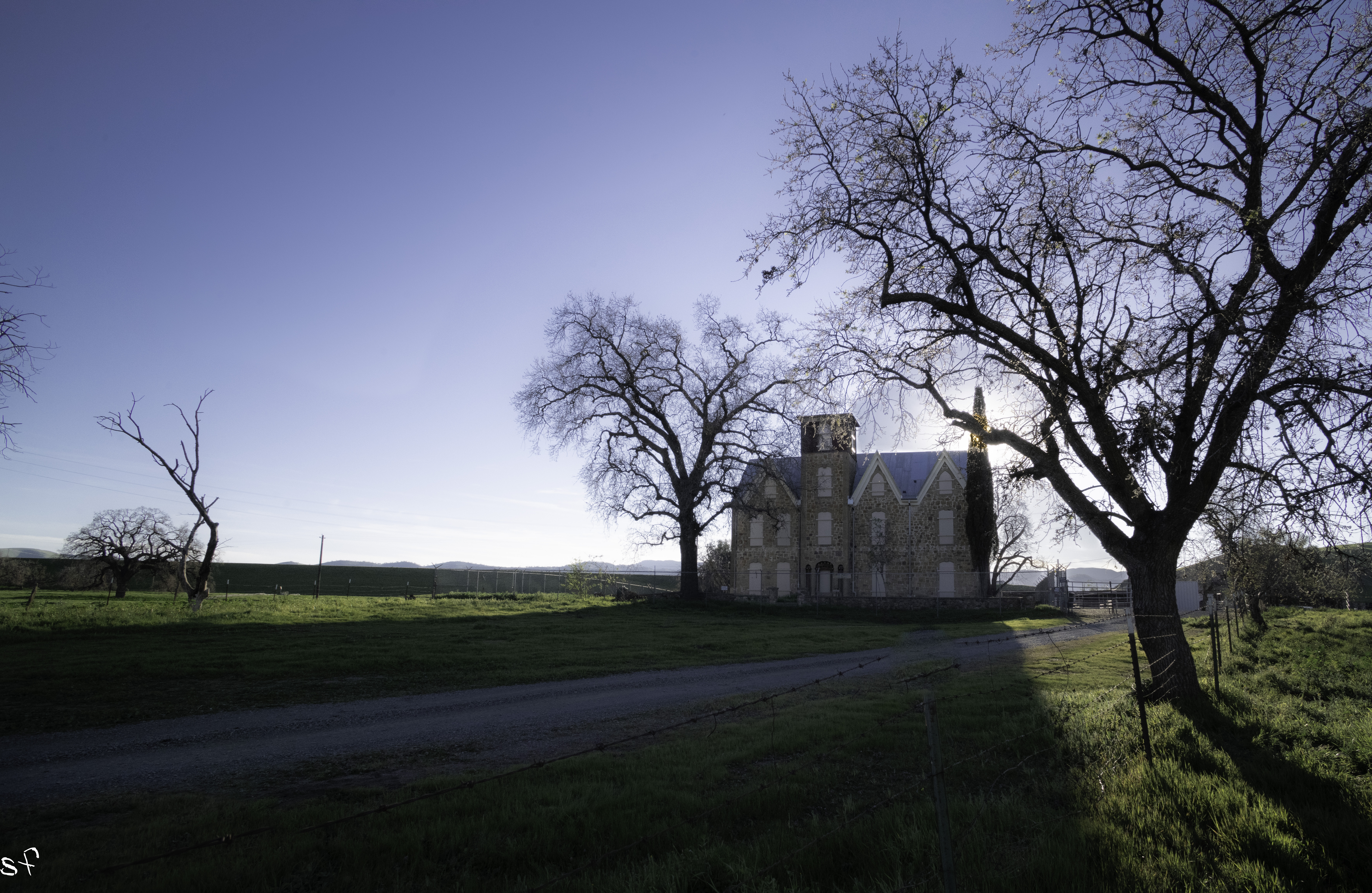 Marsh had more than one dog in the race that day, he made a living selling to miners and migrants, and his outpost would be sold dry of hard tack and salted pork, he also would have made as much as any horse trader on the herding of the California mustang to Mexico. Other than the incident with Claudio Feliz, I can find no proof of this, but I find it hard to believe that he wouldn’t have had dealings with Murrieta, one Joaquin or another, selling horses that were included in the herds driven to Mexico.
Starting out on the sixteenth of the month, the drove headed to Brushy Creek, 25 miles to the south, where the first overnight corral stood along La Vereda del Monte. Marsh’s dogs would be yapping, and there would be guns shot into the air and dust and hooves passing a field of bleached bones of the dead cattle who didn’t make it through the drought, run over by the fever of vaqueros ripping the air with reatas and whistling. The rodeo was no secret, every vaquero east of Diablo made his wage on livestock, rounding, roping, driving to market. Cattle and sheep were driven to San Francisco and butchered. The California mustang, with a population run feral from the mission days, had increased to over 24,000 by 1800. So many, that they were driven off the cliffs at Santa Barbara by the thousands, because they forged on the range where cattle were raised. Now they had a new market and every vaquero from Stockton to the Pacific Ocean would know that. More profitable than meat or hides each horse, according to Latta, fetched $$ in Sonora, and all it required was the round-up. No easy task, admittedly – I remind you, these were some of the most athletic horses in the world – so, it was common understanding that any one who roped an unbranded one, deserved undisputed ownership.
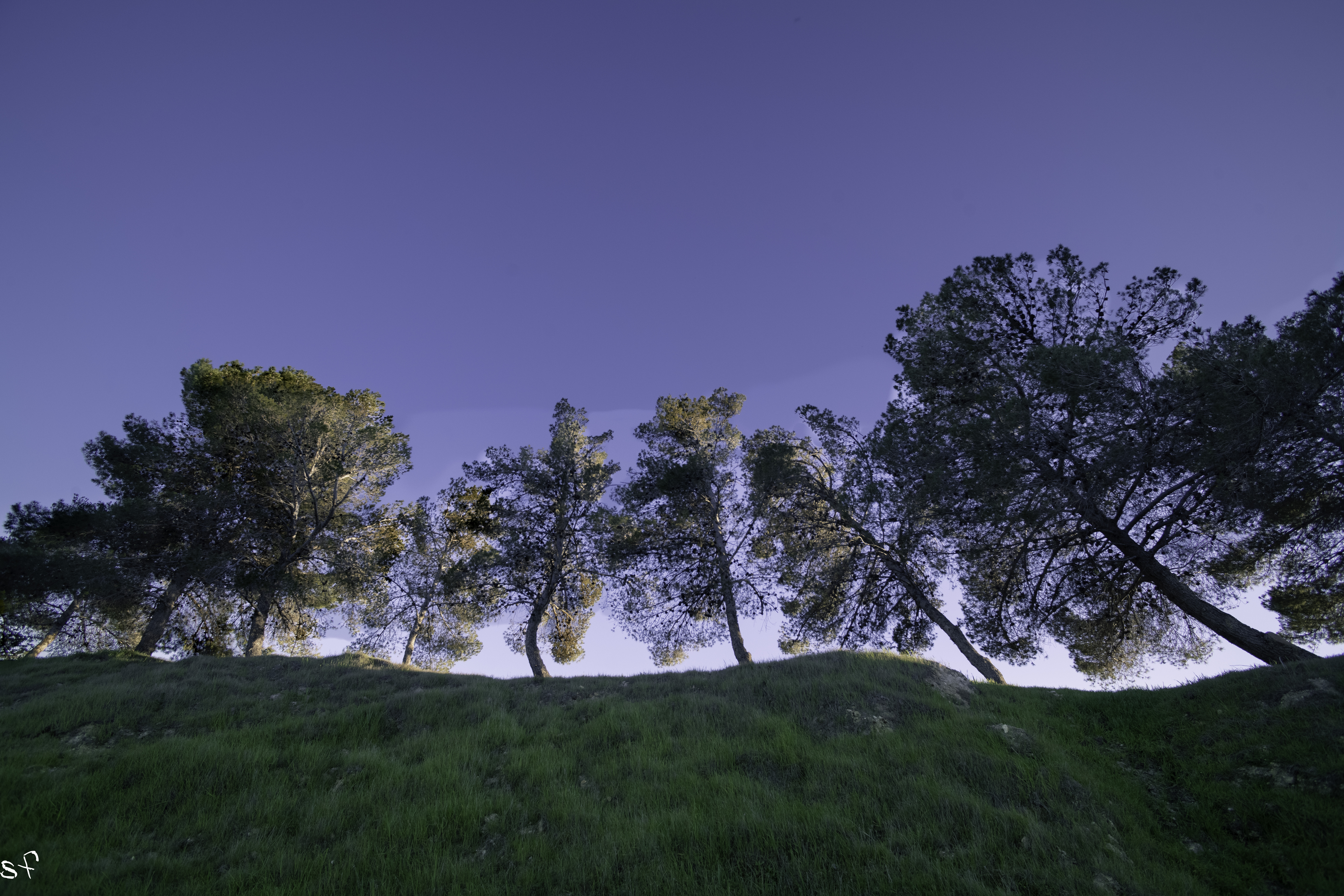
trees along Camino Diablo, the trail moves south from Point of Timber.
Mero Love Life and Death on the California Frontier – (Abby would never tell her family the true dangers of living on an isolated California rancho. Less than seven months before Abby married John Marsh, the ranch had been attacked by a band of outlaws led by Claudio Feliz, Joaquin Murrieta’s brother-in-law. Claudio mounted an armed assault on Dr. Marsh’s Rancho Los Meganos, on December 5, 1850. After spending a pleasant afternoon as a guest of John Marsh, Claudio returned that night with a dozen outlaws armed with guns and lances. They overran the rancho, captured Marsh, looted the adobe ranch house, and just for fun, speared to death William Harrington, an unresisting Anglo visitor. The bandits escaped with $300, gold watches and guns. The attacks by outlaws on isolated East Bay ranches continued well into the 1860’s.)

