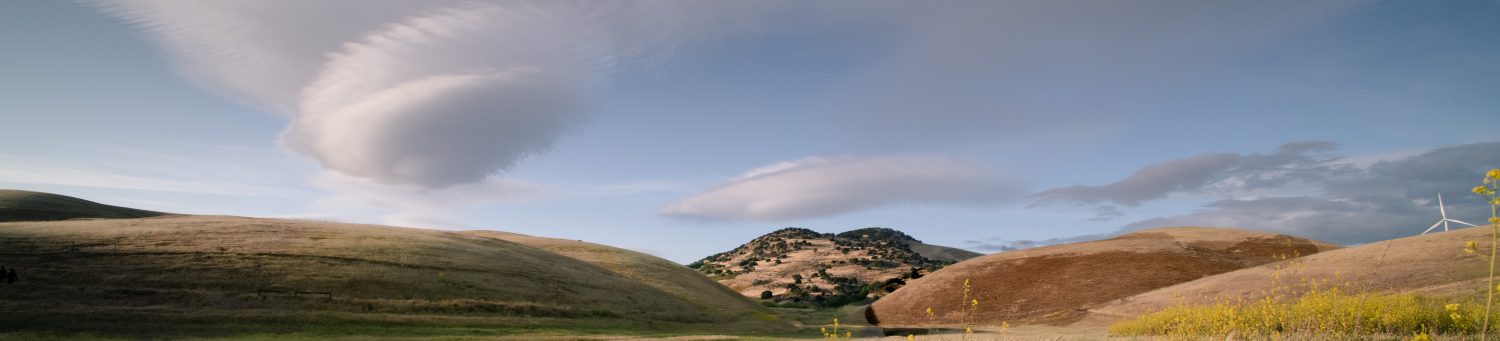

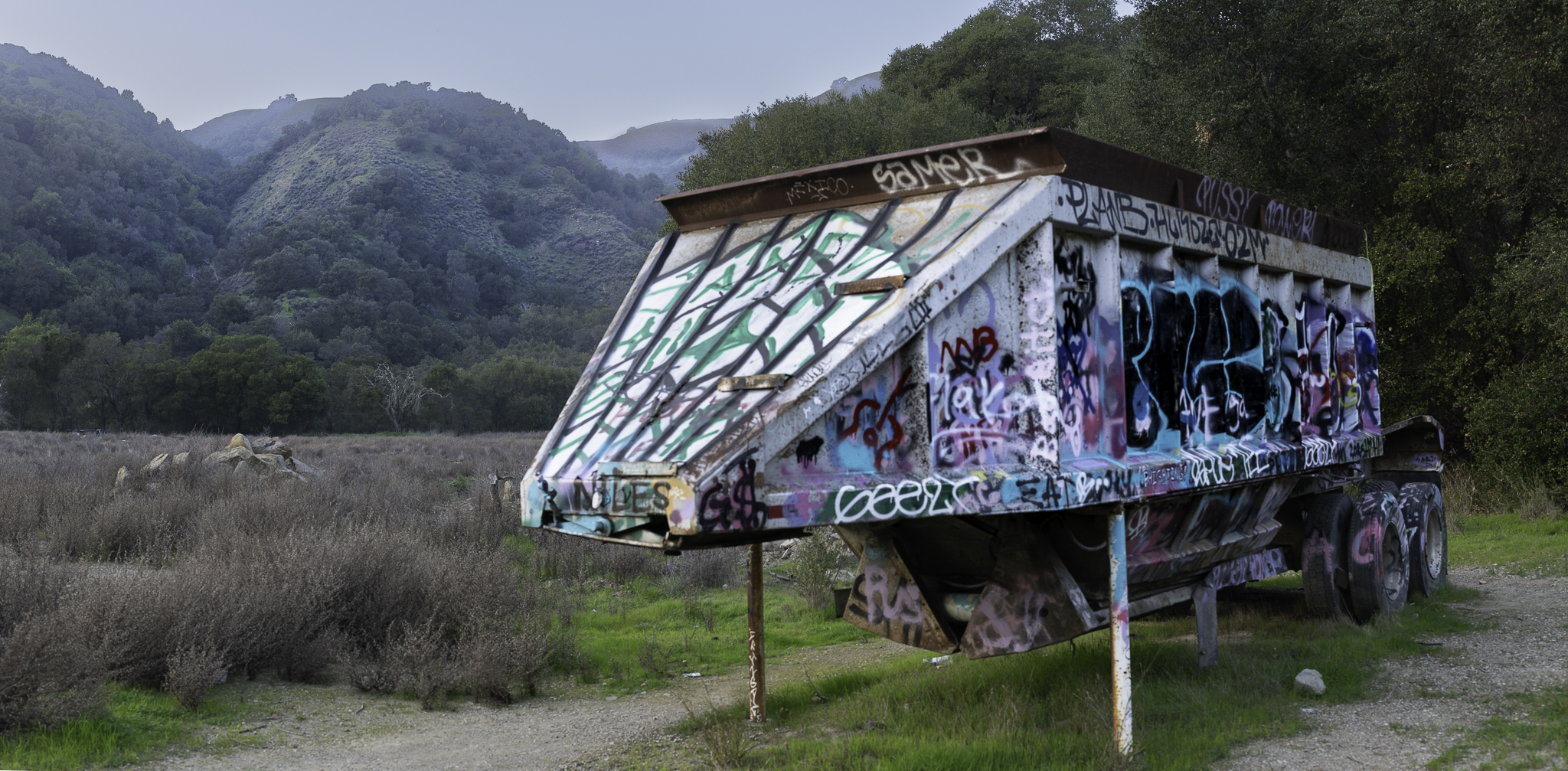
I feel a like a pirate looking for his bones and have just come across Davy Jone’s locker. Not much of photo, but even this trailer-rig has a history, probably in the demolition of the California Pressed Brick factory, built in 1907, with one of its kilns, twenty-five feet tall, once upon a time, standing behind me, just about where I’m standing to frame this picture.
In 1967, Frank Latta was in Niles researching material for what turned into his masterwork, Joaquin Murrieta and his Horse Gangs; he photographed the old brick factory and claims Murrieta’s abode was 400 yards down the creek – in this picture, the creek is just across the field – along the tree line and to the left, toward Vallejo’s Mill. Latta has authority here, he followed the trail of Murrieta for much of his adult life, taking time off his high school teaching career to visit places as far off as Mokelumne Hill, or Sonora, Mexico, dragging his wife and kids along in the 34’ Hudson on some kind of vacation/road trip to interview anyone who had stories to tell. That’s how obsessed he was. His contribution to Murrieta’s study is not only invaluable, but inspirational. However, he didn’t always get it right. Many of his interviews are oral accounts we would call field research – stories told by relatives, cousins, sons of nieces, acquaintances. Verification in some cases is problematic. The way I see it, if a story is told again and again, it is worth listening to. It doesn’t mean that’s it’s true, but that there is a truth in it. What I’m referencing here are the truths that we find in mythology, or its close kin, folklore, often exaggerated, but not spun from whole cloth, and at its heart, a nugget reaches beyond history and encounters conditions and energies that we find in antiquity. These energies have been around for a while, have been repeated and verified. A cursory glance at the grail quest will attest to the relevance of King Arthur, or the historical accuracy of Homer. Perhaps for this reason the truth we find in a myth is more profound than other truths. I’m not sure I want to build the argument any further here, but I do find a myth more interesting than simple facts. Of course, it’s all the more interesting if you can substantiate it. The hilt of Excalibur, found at the bottom of a bog, recently drained to put up a sub-division, in Co. Mayo, Ireland, might have an impact. But finding Murrieta’s bones? I’m not sure what might be awakened by exhuming his bones, but one thing is certain, there is a story here.
You can easily argue that the Murrieta tale is a classic expression of mythology, springing from folklore, much as the fugitive Robin Hood, he captures the fugitive adventurer as an ancient type who resonates across generations. Poems, plays, the endless inspired quest, this is the dimension we embrace when we enter such a realm. If we examine the archetype of Joaquin, we are certainly looking at a character with ‘above average qualities’ whether they be positive attributes, or take a darker course, is up for grabs. He is wounded, a fugitive, a rebel, a fighter, buffeted by circumstances, a leader of men, ill treated by his fellow man, even the fates in the end, cut him short. With the tale of Murrieta, we come to the proverbial question, do the ends justify the means? In this case, does the stealing of two gold mining claims – either one would have made him a wealthy man, the murder of his brother, strung up in front of him, strapped to the very tree, watching his wife, who was his childhood sweetheart, writhe in agony and shame as she tried to resist being raped repeatedly, right in front of his eyes, and raped again, all the while lashed with a rawhide whip until he passed out.
Some of Latta’s interviews have extraordinary insight, others might inspire one to speculate, and still others may be less reliable, but the conjecture that Murrieta lived, after the massacre at Cantua Creek and ended up mortally wounded in Niles, to be buried underneath the house that he leased from Jesus Vallejo, is a provocative one. To find the bones of Joaquin would resolve history, but as I walk over the clay loam fields outside of Niles, just in front of the old brick factory, I’m not so much interested in his bones as I am in understanding Murrieta as a person. His bones may rest, purely as a metaphor, and who knows, maybe in the back of this dumpster. As I raise my head and look at the oak trees around me, the smell of the creek gives off the stank of rotting mud and frogs and clay, and it reminds me of the time my boots got stuck when my grandpa took me duck hunting in the tulles along the levy
 imagicos